
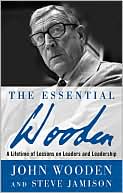
What I am reading: Lessons from Wooden

John Wooden was an amazing basketball coach. I always admired him because while he cared about winning he also spent much of his time helping his men develop character. His book helps frame up some of the things he has learned over the years and outlines his approach to his coaching career.  He hits 2 main points over and over again. While he does not list then in this way they are present throughout his writing.


  1. Lessons he learned from his father.
  2. Lessons he learned from observation.

These 2 types of lessons are extremely valuable when considering his definition of success. To Wooden success is doing your absolute best effort. Winning a game or even championship may come as a result of your best effort or it may not. Ultimate success however is not determined by the terms of points or sales. Those things may mean a goal was achieved but do not indicate the success that matters at the end of your life.

Lessons from his father.

You can see the influence of his father in this statement taken from page 145 when he says “my dad taught me not to measure in comparison to others but rather on the quality of my efforts to improve.” Clearly that impacted his understanding of what success really was. He speaks of it being an evolving concept that took a stronger hold as he got older.

Lessons from observation.

Throughout the book he speaks of times in his career when he did things wrong or when he adjusted things as he moved on as well as understood people. On page 146 he says, “For a period of years at UCLA I was guilty of worrying over some issues that I could do nothing about.” However, he continues, “Eventually, I overcame it…” This is the important because it lends to never stop learning. (That is another post altogether.)

Throughout the book He continually makes statements of wisdom that I believe come from one of either of these sources. Here are a few of my favorite.

  • If you can’t control your emotions, your emotions will control you. (27)
  • Self-control contributes to consistency in all areas that matter. (40)
  • In any context, what happens after a missed opportunity, mistake or failure is crucial. (71)
  • Effort is the measure of a man. (85)
  • While I could nourish and test character, give the young man a chance to show character, I was not able to instill character where it did not exist. (104)
  • Have the courage to be yourself; have the intelligence to make yourself as good as you can be. (146)
  • Adversity thins the ranks of your competitors. (153)
  • Passion is temporary. (171)
  • The force of character is cumulative. (192)

What is it to you?

  • Read the whole book. If you think any one of the statements above is true or applicable to where you are or where you want to go then you need to read this book. The value in it is tremendous.
  • Teachings of your father. Revisit all the things that you learned from your dad. Some he may have said and others he may never have said but were shouted loud and clear by his actions. These are sometimes the more important lessons that take us years to comprehend.  Revisit these lessons and think on them and how they have impacted your life.
  • Lessons from observation. Your observations could be in hindsight of any of your experiences or from those experiences that you have observed others going through. Thinks through those days and moments that shaped who you are and how they have impacted your life.

The Third’s Theory

If you are anything like me, you have spent many days wondering why you work harder than many of your peers, who seem to be content with letting you be the best and them taking the back seat in the bus.

Which third are you?

The answer that many people provide to us is that we do it for ourselves, our name, a higher purpose, the list goes on. I do agree that these can all be true however there seems to be a truth here that they miss, or just fail to mention, every time. That is the focus on the other people, not to berate them or put them down but to understand what is going on so that we can lead them and help them perform to their fullest. This is where The Thirds Theory comes into effect.

I remember my father teaching me this principle growing up. Since then I have found it to be true at every step of my growth and development in my journey. My father saw it at the Police Department that he served, I saw it in the U.S. Marine Corps and again at school as I earned both my undergrad and graduate degrees, and every place of employment I have worked at.

OK so here it is…

The Third’s Theory states that in any organization…

  • 1/3 of the people should not be working there,
  • 1/3 of the people need to be retrained but have great potential, and
  • 1/3 of the people are right where they need to be and carrying the burden.

Why is this so important? Well that depends on where you are among the thirds.

If you are among the peers and realize this is not where you should be then, frankly, do everyone a favor and look for other employment or seek a transfer to a part of the company that might better suit you.

If you find yourself among your peers and realize you need to be retrained then seek opportunities to do so with either your supervisor or with those that you know among your peers who are right where they need to be.

If you find yourself in the third that is right where you should be then Congratulations! You need to find ways to start immediately training the other 2/3’s of your peers. You are in no place to decide who should go home, however if you know you are in the top third then so do they, therefore – Start retraining them on all the pieces of what you do to improve the overall performance of the team.

If you find yourself as the supervisor – then this should be quite significant to your operations during the next two weeks. If you can handle these 3 simple steps in the next few weeks you should see a raise in performance among your entire team. Here is what you need to do…

  1. Identify who are in the top third.
  2. Have the top third begin re-training the other two-thirds. At this point it is not necessary to label the third that needs to go home. Through the re-training they will identify themselves and you will have something to evaluate.
  3. Focus on re-training.

Take Action. After reading this – immediately identify which third you are in, decide what you are going to do to help the team, and then speak to your team about how you can help them grow as well.

The Context of Leadership

The Context of Leadership

There may be many potential platforms for each of us. The context of leadership is determined by which platforms we take an active role in. The context of our leadership differs with each of the platforms that we take. This is where our individual priorities will show. What we value as a person is where we will choose to lead, and seek platforms to do so.

The context of where you lead determines much of how you interact with the platform and the people you are attempting to lead. Below are a few of the more popular context that we see.

  • Family Leadership.
  • Church or Ministry Leadership.
  • Educational Leadership.
  • Military Leadership.
  • Political Leadership.
  • Moral Leadership.
  • Business Leadership.
  • Spiritual Leadership.

As we set our priorities in our daily lives we (meaning those of us who desire to lead) will take active roles leading in the most important areas of our world. This is not a time to disparage those who are active in a different context but find our own context and then pursue it.  Choosing the contexts that you would like to pursue will also be highly impacted by your personality and your talents. A quite reserved person may not be looking for a context or platform where they are in front of people on a regular basis. Pursue growing as a leader, your contexts might change but with each attempt you will grow and be more effective.

Conclusion

It may be difficult to define leadership; I suggest that it is just as difficult to explain. I understand that this does not answer all the questions nor does it explain every aspect of what a leader does. I have made an attempt according to how I understand leadership as I continually pursue to be a better leader. I hope that it challenges some and entices others to continue in your journey of leadership.

The Opportunities for Leadership

There are many times when, in discussion, you will hear someone refer to another as a leader. While being a leader may be a quality that we admire we need to understand that because someone may have BE a leader it does not necessitate that at that very moment they are practicing leadership. There are many times in my life when I would consider myself a leader but I was only one of many. For example, during my time in Boot Camp for the Marines, I was a leader and given the opportunity to lead I took it, but on many occasions I was just getting yelled at or sitting in a chair leading absolutely nothing.

The capacity to lead or the willingness to lead to not necessarily mean I am doing so. When looking at leadership we must realize that without opportunities for leadership we are just willing participants, who may even have the capacity, but are waiting to get in the game.

Opportunities can be presented to you as platforms or can be created by our own initiative.

Presented platforms gain you positional opportunities for leading others. These are the opportunity that just about everyone has, whether they take them seriously or not. Some common platforms…

  • Being a Husband. You are in a position to lead your spouse.
  • Being a Parent. You have the position to lead your children.
  • Being an Employer or Supervisor. You have the position to lead your employees or subordinates.
  • Being a Teacher. You have the position to lead your students.
  • Being a Coach or Captain of the team. You have the position to lead your team.
  • Being the President. You have the position to lead a nation.
  • Being the Pastor. You have the position to lead a church.

Created platforms are the ones that we see as vacant, stand up, and lead under our own compelling. We can be compelled by our desire to help, our desire to fix, or our own frustration with what we see. Some examples are…

  • The guy who wants to lead his friends and steps up to do it without being chosen.
  • The person who in the middle of a fire alarm stands up on a table and gives direction in chaos.
  • The older, wiser woman who in a town meeting sees the division beginning and quietly gives direction to bring unity.
  • The woman who is tired of waiting for a man to take office that will not abuse its power but serve the people then steps up and puts her own name in to make the difference.
  • The young man on the football team who sees his teammates, including the captain, heads hanging low and gathers them together to rally the team and attempt to turn this thing around.
  • The young woman who in a tough time after losing her mother becomes the mother to her younger siblings because someone has to.

If you notice the created platforms are created in times of adversity. That is because adversity gives way to greatness. True leaders, when adversity strikes are compelled by their own capacity to lead. This is where I would say that, for many leaders, the act of leading in adversity is a moral issue. If I see the pain and hurt and do not attempt to right it or mend it in some way, I will not be able to sleep peaceably tonight.

Whether you currently hold opportunities of presented or created platforms you need to recognize what opportunities you hold because they will determine your context of leadership. We will look at the differing contexts next week.